
Introduction
In today’s competitive digital world, businesses need more than just online visibility. They need measurable results such as website traffic, leads, sales, app installations, and conversions. This is where Performance Marketing plays an important role.
Performance Marketing is a results-driven approach to online advertising where businesses measure campaigns based on specific actions and outcomes. Instead of focusing only on impressions or reach, marketers track important metrics such as clicks, leads, conversions, cost per acquisition (CPA), return on ad spend (ROAS), and revenue.
For students, freshers, and working professionals, learning what is performance marketing can open the door to several career opportunities in digital advertising, paid media, analytics, and marketing strategy.
What Is Performance Marketing?
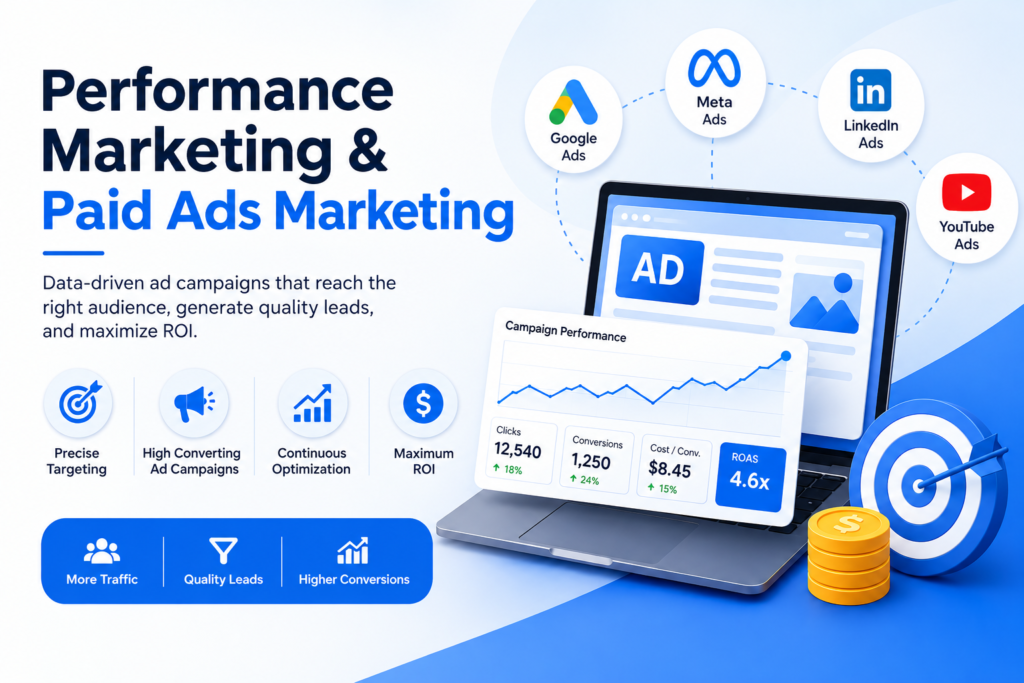
Performance Marketing is a type of digital marketing in which advertisers focus on measurable actions and business results. These actions can include clicks, form submissions, purchases, app downloads, registrations, or qualified leads.
For example, suppose an online clothing store spends ₹20,000 on an advertising campaign and generates ₹80,000 in sales. The marketer can analyze the campaign’s cost, revenue, conversion rate, and ROAS to determine whether the campaign was successful.
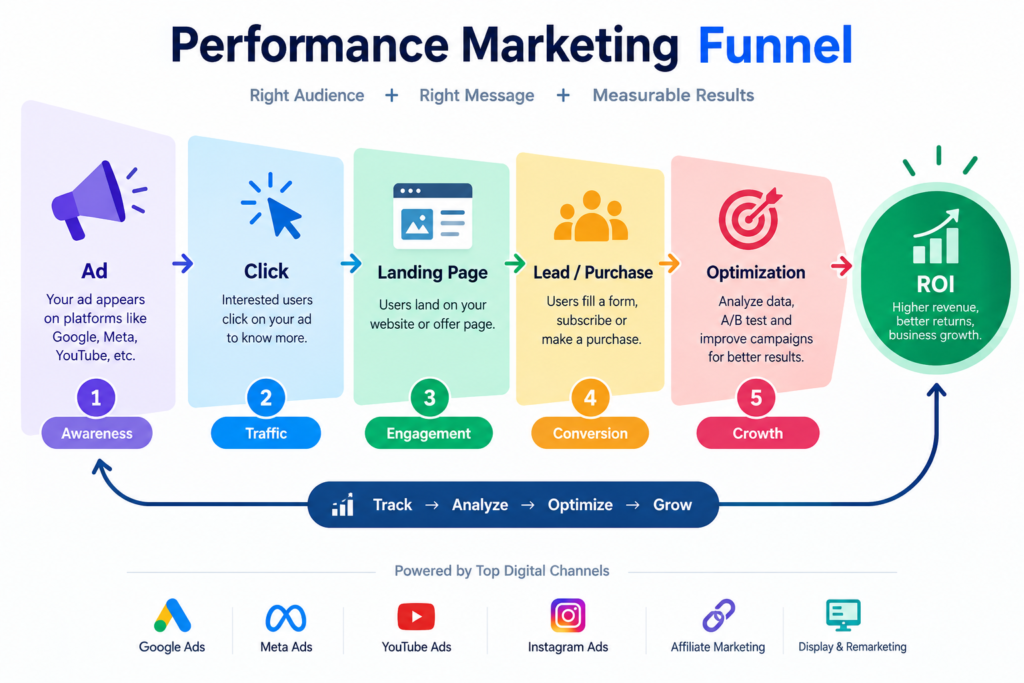
The key idea behind performance-based advertising is simple: measure the result, analyze the data, optimize the campaign, and improve performance.
This makes Performance Marketing especially valuable for businesses that want to understand where their marketing budget is going and what results it is generating.
What Is Performance Marketing in Digital Marketing?
What is performance marketing in digital marketing? It is a results-oriented part of digital advertising that uses online channels to generate measurable business outcomes.
Unlike traditional advertising, where businesses may pay for exposure without knowing exactly how many customers they will receive, performance campaigns are continuously monitored using data.
Common channels include:
- Google Ads
- Meta Ads
- Instagram advertising
- YouTube Ads
- Display advertising
- Affiliate marketing
- Search engine marketing
- Remarketing campaigns
- App advertising
For example, a company can run Google Ads for a specific product, track how many people click the advertisement, measure how many users purchase the product, and calculate the overall return from the campaign.
What Does Performance Marketing Do?
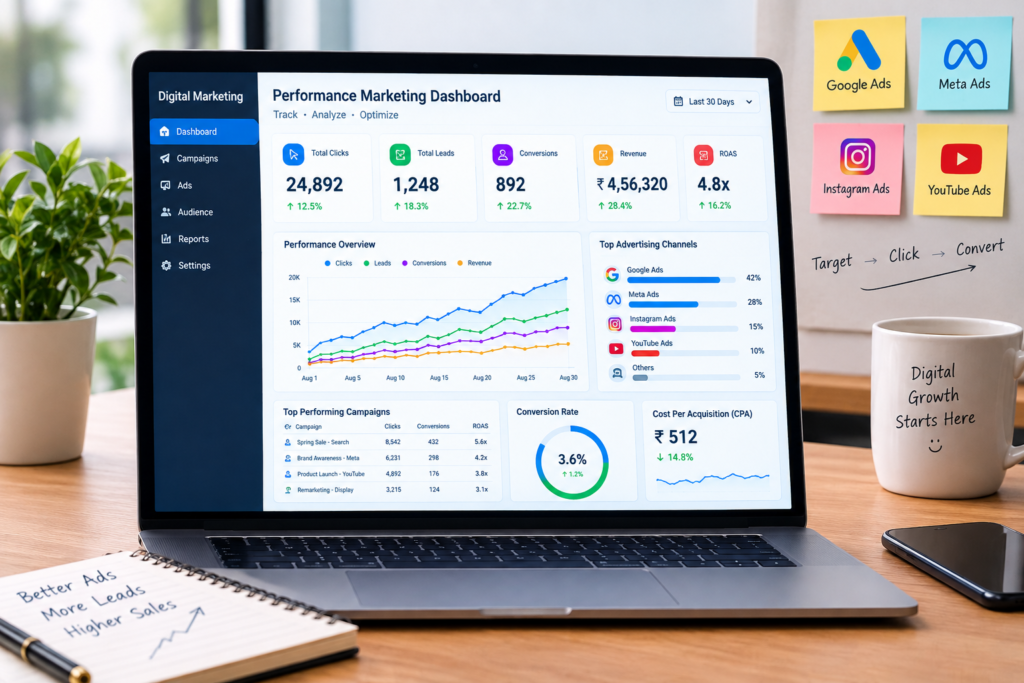
So, what does performance marketing do? Its main purpose is to help businesses generate measurable results from their marketing investment.
A Performance Marketer generally:
- Understands the business and target audience.
- Defines campaign goals.
- Selects suitable advertising platforms.
- Creates and launches campaigns.
- Monitors campaign performance.
- Studies audience and conversion data.
- Tests different advertisements.
- Optimizes budgets and targeting.
- Reduces unnecessary advertising costs.
- Improves conversions and return on investment.
The exact objective depends on the business. An e-commerce company may focus on purchases, while a service company may focus on leads and enquiries.
What Is Digital Performance Marketing?
What is digital performance marketing? It is the use of digital platforms, advertising technology, tracking systems, and data analytics to achieve measurable marketing objectives.
Digital Performance Marketing combines advertising with analytics. Marketers don’t simply launch an advertisement and wait for results. They continuously evaluate performance and make changes based on data.
For instance, if one advertisement generates 100 clicks but only two conversions while another generates 50 clicks and ten conversions, the marketer may allocate more budget to the second advertisement.
This continuous optimization is one of the biggest advantages of digital performance marketing.
Performance Marketing vs Traditional Marketing
Performance Marketing and traditional marketing have different approaches.
| Factor | Performance Marketing | Traditional Marketing |
|---|---|---|
| Main focus | Measurable results | Reach and awareness |
| Tracking | Highly measurable | Often difficult to measure |
| Optimization | Continuous | Usually slower |
| Targeting | Highly specific | Often broader |
| Budget control | Flexible | Less flexible |
| Reporting | Detailed digital data | Often estimated |
| Examples | Google Ads, Meta Ads | TV, newspapers, billboards |
This does not mean traditional marketing is ineffective. Instead, Performance Marketing gives businesses more detailed data about how their advertising budget is performing.
Major Performance Marketing Channels
1. Google Ads
Google Ads allows businesses to advertise when users search for relevant products, services, or information. Search campaigns can be highly valuable because they can reach users who already have a specific intent.
2. Meta Ads
Meta advertising allows businesses to reach audiences through platforms such as Facebook and Instagram. Advertisers can use audience targeting, creative testing, retargeting, and conversion optimization.
3. YouTube Advertising
YouTube Ads can be useful for video-based campaigns, brand awareness, lead generation, and product promotion.
4. Affiliate Marketing
Affiliate marketing involves partners promoting a company’s products or services and receiving a commission for qualifying results.
5. Display and Remarketing
Display advertising can help businesses reach audiences across websites and digital platforms. Remarketing can reconnect with people who previously visited a website but did not complete the desired action.
Important Performance Marketing Metrics
Understanding metrics is essential for anyone learning Performance Marketing.
Click-Through Rate (CTR)
CTR shows the percentage of people who clicked an advertisement after seeing it.
Cost Per Click (CPC)
CPC indicates how much an advertiser pays, on average, for each click.
Cost Per Lead (CPL)
CPL measures the average cost of generating one lead.
Cost Per Acquisition (CPA)
CPA shows the average cost required to acquire a customer or complete a defined conversion.
Conversion Rate
Conversion rate measures the percentage of visitors who complete the desired action.
Return on Ad Spend (ROAS)
ROAS compares advertising revenue with advertising expenditure.
For example, if you spend ₹10,000 and generate ₹40,000 in attributed revenue, the ROAS is 4x.
Return on Investment (ROI)
ROI considers the overall financial return compared with the investment and can provide a broader view of profitability.
Skills Required for a Performance Marketing Career
Students and freshers who want to build a career in this field should develop both technical and analytical skills.
Important skills include:
- Google Ads fundamentals
- Meta Ads fundamentals
- Keyword research
- Audience targeting
- Campaign creation
- Conversion tracking
- Google Analytics
- Landing page optimization
- Copywriting
- Data analysis
- A/B testing
- Budget management
- Reporting and presentation
Working professionals can also benefit from learning these skills because businesses increasingly require marketers who can connect advertising expenditure with measurable business outcomes.
How to Choose a Performance Marketing Course
If you are considering a course, don’t choose one only because it has a low price. Compare the complete learning experience.
1. Course Curriculum
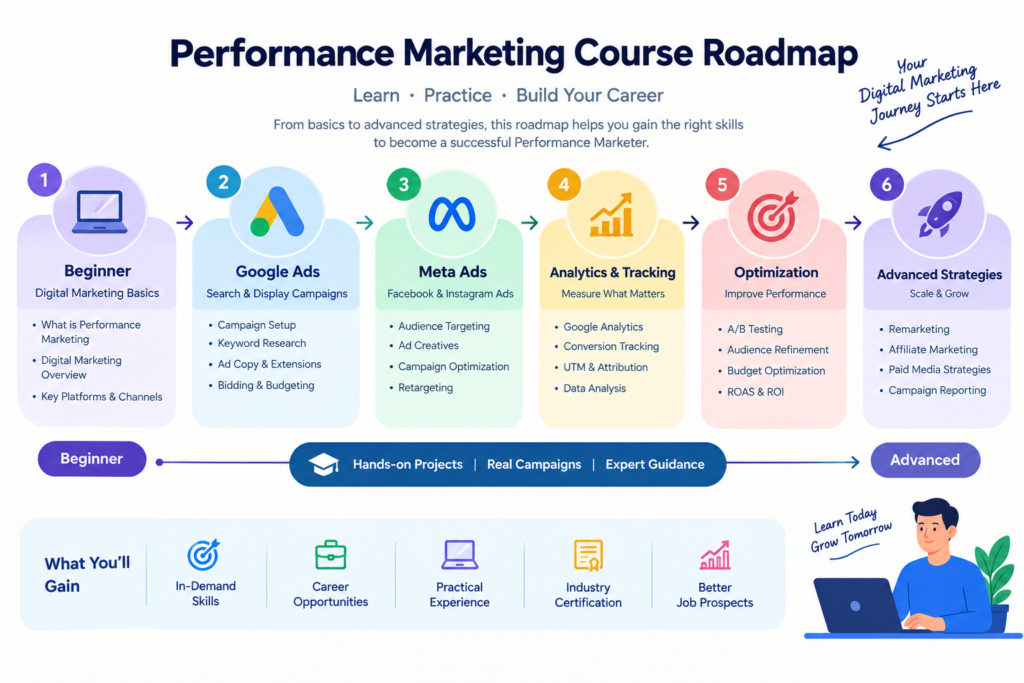
Check whether the course covers Google Ads, Meta Ads, analytics, conversion tracking, remarketing, campaign optimization, and reporting.
2. Practical Training
Practical assignments and real campaign simulations can help students understand how advertising platforms work.
3. Live Projects
A course with practical projects can help learners build confidence and demonstrate their skills to potential employers.
4. Trainer Experience
Research the instructor’s practical experience and industry background before enrolling.
5. Certification
A certificate can support your resume, but practical knowledge and project experience are equally important.
6. Placement or Career Support
Freshers should check whether the institute provides interview preparation, resume assistance, internships, or placement support.
Performance Marketing Course Fees
The Performance Marketing course fees can vary significantly depending on the institute, course duration, curriculum, trainer experience, and practical training included.
Short-term introductory courses may cost less, while comprehensive programs with live projects, advanced advertising modules, analytics, and career support may have higher fees.
Before paying the course fee, compare:
- Total course duration
- Number of modules
- Live classes
- Practical assignments
- Live projects
- Certification
- Trainer experience
- Internship opportunities
- Placement assistance
- Post-course support
Rather than choosing a course only based on price, consider the overall value and skills you will gain.
Performance Marketing Course Duration
The Performance Marketing course duration depends on the course structure and level.
A basic course may be completed within a few weeks, while a comprehensive program can take several months. Beginners should ideally choose a course that provides enough time for both theoretical learning and practical implementation.
A good learning plan should cover fundamentals first and then progress toward campaign setup, tracking, optimization, analytics, and advanced strategies.
Career Opportunities in Performance Marketing
Learning Performance Marketing can prepare learners for several digital marketing roles, including:
- Performance Marketing Executive
- Paid Ads Specialist
- Google Ads Specialist
- Meta Ads Specialist
- PPC Executive
- Digital Advertising Specialist
- Paid Media Executive
- Performance Marketing Manager
With experience, professionals can move into strategic positions where they manage larger budgets, teams, clients, and multi-channel campaigns.
Benefits of Learning Performance Marketing
There are several reasons why students, freshers, and working professionals consider learning this field.
High demand: Businesses across industries use digital advertising to reach customers.
Measurable results: Campaigns can be evaluated using detailed performance data.
Practical career skills: Learners can develop skills that are directly applicable to digital advertising.
Freelancing opportunities: Skilled professionals can potentially work with multiple clients.
Business opportunities: Entrepreneurs can use paid advertising to promote their own products or services.
FAQs About Performance Marketing
What is performance marketing?
Performance Marketing is a results-focused digital marketing approach where campaigns are measured according to actions such as clicks, leads, sales, registrations, or conversions.
What does performance marketing do?
It helps businesses generate measurable outcomes from advertising campaigns by tracking results, analyzing data, optimizing campaigns, and improving marketing efficiency.
What is performance marketing in digital marketing?
It is a results-oriented area of digital marketing that uses platforms such as Google Ads, Meta Ads, YouTube, affiliate networks, and other digital channels to achieve measurable objectives.
What is digital performance marketing?
Digital Performance Marketing uses digital advertising platforms, analytics, tracking, and optimization techniques to generate measurable business results.
Is Performance Marketing a good career for freshers?
Yes. Freshers can start with foundational skills in paid advertising, analytics, campaign management, copywriting, and conversion optimization and gradually build professional experience.
How much does a Performance Marketing course cost?
Course fees vary according to the institute, duration, curriculum, practical training, projects, certification, and career support. It is better to compare these factors before choosing a course.
How long does it take to learn Performance Marketing?
The learning period depends on your starting knowledge and course structure. Basic concepts can be learned relatively quickly, while becoming proficient requires consistent practice and campaign analysis.
Which is better: Performance Marketing or traditional marketing?
Both have their uses. Performance Marketing provides detailed digital tracking and optimization, while traditional marketing can be useful for broader brand awareness and offline reach.
Conclusion
Performance Marketing has become an important part of modern digital advertising because it connects marketing activities with measurable business results. From Google Ads and Meta Ads to analytics, remarketing, and conversion optimization, it gives marketers the ability to understand what is working and improve campaigns using data.
For students, freshers, and working professionals, learning what is performance marketing, what does performance marketing do, and what is performance marketing in digital marketing can provide a strong foundation for building a career in paid advertising and digital marketing.
If you are planning to enroll in a Performance Marketing course, compare the curriculum, practical training, course duration, fees, projects, certification, and career support before making your decision. Most importantly, focus on gaining practical skills rather than simply collecting certificates.
With continuous learning, hands-on practice, and an understanding of advertising data, Performance Marketing can become a valuable and rewarding digital marketing skill.