
Introduction: What Is SEO?
If you have ever searched for something on Google and wondered why some websites appear on the first page while others are difficult to find, the answer is largely related to SEO.
So, what is SEO? SEO stands for Search Engine Optimization. It is the process of improving a website, its content, structure, and overall online presence so that search engines can better understand it and users can discover it through organic search results.
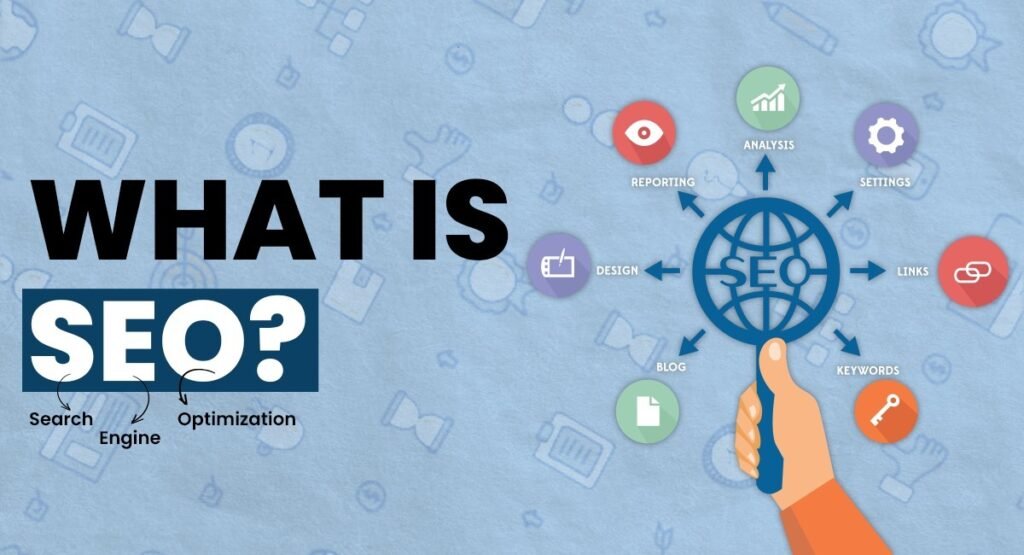
Google explains SEO as helping search engines understand your content and helping users find your website through search. SEO focuses on organic visibility, meaning traffic that comes from unpaid search results.
For students, freshers, bloggers, business owners, freelancers, and working professionals, learning SEO can be a valuable digital marketing skill.
In this guide, we will explain what is SEO in digital marketing, what is search engine optimization, how SEO works, the benefits of SEO, SEO course duration, SEO course fees, and how to choose the right SEO course. You will also learn what is SEO, why SEO is important for businesses, and how search engine optimization can improve your website’s visibility on search engines.
What Is Search Engine Optimization?
What is search engine optimization? Search Engine Optimization is the practice of optimizing web pages so search engines can crawl, understand, index, and potentially rank them for relevant searches.
For example, suppose you have a website about digital marketing and publish an article targeting the keyword “what is SEO.” You can optimize the article’s title, headings, content, internal links, images, technical structure, and other relevant elements.
However, SEO is not a guarantee that a page will rank at number one. Google states that even pages meeting its technical requirements and best practices are not guaranteed to be crawled, indexed, or served in search results.
The major areas of SEO include:
1. On-Page SEO
On-page SEO focuses on elements that you can optimize directly on your website.
Important elements include:
- Keyword research
- Meta title
- Meta descriptions
- Size of headings
- Alternative text (Alt text)
- Internal link
- External link
- Permalink
- Keyword stuffing
The objective is to make the content useful for users and easier for search engines to understand.
2. Technical SEO
Technical SEO focuses on the technical aspects of a website.
It can include:
- Crawling
- Indexing
- Robots .txt
- Page performance
- Site architecture
- Canonical URLs
- XML sitemaps
- HTTPS
- Structured data
- JavaScript SEO
- Schema markup
Google’s documentation specifically highlights technical requirements, crawling, indexing, structured data, and Search Console as important areas for improving search visibility.
3. Off-Page SEO
Off-page SEO involves activities outside your website that can contribute to its authority and visibility.
Examples include:
- Profile creation
- Search Engine Submission (S.B.S)
- Social Book Marking (S.B.M)
- Ad / Classified submission
- Infographic / image submission
- Quora Submission
- Blog Submission
- Blog Commenting
- Web 2.0
The focus should be on earning genuine, useful links rather than using spammy link-building tactics.
4. Local SEO
Local SEO helps businesses become more visible for searches with local intent.
For example:
“digital marketing agency near me”
or
“best restaurant in Delhi”
Local SEO can involve optimizing a Google Business Profile, maintaining consistent business information, collecting legitimate reviews, and creating useful location-specific content.
What Is SEO in Digital Marketing?
Now let’s understand what is SEO in digital marketing.
SEO is one of the major components of digital marketing. Digital marketing includes multiple channels such as:
- SEO
- Search engine marketing
- Social media marketing
- Email marketing
- Content marketing
- Affiliate marketing
- Influencer marketing
- Paid advertising
SEO primarily focuses on attracting relevant users through unpaid search results.
For example, imagine you sell shoes online. Instead of paying for every visitor through an advertisement, you could create useful pages targeting searches such as:
- Best running shoes
- Running shoes for beginners
- Men’s sports shoes
- Best shoes for walking
If those pages gain visibility in relevant organic searches, they can bring visitors without paying for every individual click.
This is one reason businesses invest in SEO.
What Is SEO and How It Works?
The basic SEO process can be understood in five stages.
Step 1: Keyword Research
First, identify what your target audience searches for.
For example:
Primary keyword: what is SEO
Related keywords:
- what is SEO in digital marketing
- what is search engine optimization
- what is SEO and how it works
- what is search engine marketing
- SEO course
- SEO course fees
- SEO course duration
Keyword research helps you understand search demand and user intent.
Step 2: Create Helpful Content
After identifying the search query, create content that genuinely answers the user’s question.
Google recommends creating helpful, reliable, people-first content and using words that users are likely to search for in appropriate areas of a page.
Avoid writing content simply to insert keywords repeatedly.
Step 3: Optimize the Website
Optimize the page’s:
- Title
- H1 heading
- H2/H3 headings
- URL
- Content
- Images
- Internal links
- Technical elements
- Metadata where appropriate
The goal is not keyword stuffing. The goal is to clearly communicate the topic while providing a good experience for readers.
Step 4: Search Engines Crawl and Index
Search engines use automated systems to discover web pages. Google says its crawlers continually explore the web and add pages to its index.
After a page is discovered and processed, it may become eligible to appear for relevant searches.
Step 5: Measure and Improve
SEO is not a one-time activity.
You should monitor:
- Impressions
- Clicks
- Organic traffic
- Search queries
- Rankings
- Click-through rate
- Conversions
- Indexed pages
Google Search Console can help website owners understand how Google sees their website and monitor search performance.
What Is Search Engine Marketing?
A common question is: what is search engine marketing, and how is it different from SEO?
Search Engine Marketing, commonly called SEM, generally refers to marketing through search engines, especially paid search advertising.
The simplest comparison is:
| SEO | Search Engine Marketing |
|---|---|
| Mainly focuses on organic visibility | Often focuses on paid search advertising |
| No payment for every organic click | Advertisers generally pay for ad clicks/impressions according to campaign setup |
| Results can take time | Paid campaigns can generate visibility quickly |
| Requires content and website optimization | Requires advertising budget and campaign management |
| Long-term traffic potential | Useful for immediate or campaign-based visibility |
SEO and paid search can work together. A business may use SEO to build long-term organic visibility while using paid advertising for immediate promotional campaigns.
Why Is SEO Important?
SEO is important because search engines can be a major discovery channel for websites and businesses.
For Students and Freshers
SEO can provide an entry point into digital marketing. You can learn keyword research, content optimization, technical SEO basics, analytics, and reporting.
For Working Professionals
SEO can be used as an upskilling option for people working in:
- Marketing
- Content
- Web development
- Business
- E-commerce
- Communications
For Businesses
A strong SEO strategy can help businesses attract people who are actively searching for their products, services, or information.
However, SEO should be viewed as a long-term marketing activity rather than a guaranteed shortcut to instant traffic.
SEO Course: What Should You Learn?
If you are considering an SEO course, don’t choose a program only because it offers a certificate.
A good beginner-to-intermediate curriculum should cover:
SEO Course Modules
- SEO fundamentals
- Keyword research
- Search intent
- On-page SEO
- Technical SEO
- Off-page SEO
- Local SEO
- Content optimization
- Website audits
- Google Search Console
- Analytics
- SEO reporting
- Competitor analysis
- Basic SEO tools
- Practical projects
A course that includes live projects and practical website work can be more useful than a course that focuses only on theory.
SEO Course Duration
The SEO course duration depends on the course level and learning format.
A basic SEO course may take around 1–2 months, while an advanced SEO or digital marketing program can take 3–6 months or longer.
For example, current Indian training listings show beginner programs around 1–1.5 months, advanced programs around 2–3 months, and broader SEO-plus-digital-marketing programs around 3–6 months.
A practical learning timeline could look like this:
| Course Level | Approx. Duration | Suitable For |
|---|---|---|
| Beginner SEO | 1–2 months | Students & beginners |
| Intermediate SEO | 2–3 months | Freshers & freelancers |
| Advanced SEO | 3–6 months | Career-focused learners |
| SEO + Digital Marketing | 3–6+ months | Complete digital marketing learners |
Remember that course duration is not the same as learning mastery. SEO requires continuous practice because search systems, websites, content strategies, and tools change over time.
SEO Course Fees in India
SEO course fees vary significantly depending on the institute, course depth, format, certification, practical training, mentorship, and career support.
Current 2026 listings indicate that short SEO programs can start at several thousand rupees, while more comprehensive programs can cost tens of thousands of rupees or substantially more.
A general comparison is:
| SEO Course Type | Approx. Fee Range | Duration |
|---|---|---|
| Basic SEO course | ₹5,000–₹10,000 | 1–1.5 months |
| Advanced SEO course | ₹12,000–₹25,000 | 2–3 months |
| SEO + Digital Marketing | ₹25,000–₹45,000+ | 3–6 months |
| Premium professional programs | ₹50,000+ | Varies |
These are indicative ranges, not fixed market prices. Fees can change between institutes and batches.
For example, one current SEO training provider lists a four-week live online SEO course at ₹20,000, showing how much pricing can vary based on delivery and course structure.
How to Choose the Best SEO Course?
Before paying for an SEO course, compare these factors.
1. Course Curriculum
Check whether the course covers on-page, technical, off-page, local SEO, keyword research, analytics, and reporting.
2. Practical Projects
Choose a course where you actually optimize websites rather than only watching recorded lectures.
3. Trainer Experience
Check whether the trainer has real-world SEO experience.
4. Tools
Find out whether you will learn commonly used SEO and analytics tools.
5. Mentorship
Live doubt-solving and feedback can make learning much easier.
6. Placement Assistance
If you are a fresher, check whether the institute provides resume support, mock interviews, internships, or placement assistance.
7. Certification
A certificate can support your profile, but practical skills and demonstrable results are generally more important than the certificate alone.
8. Total Cost
Check whether the advertised fee includes taxes, tools, certification, study materials, projects, and other charges.
Is SEO a Good Career for Students and Freshers?
Yes, SEO can be a useful career skill for students and freshers who are interested in digital marketing, content, websites, analytics, and online business.
Possible career roles include:
- SEO Executive
- SEO Specialist
- SEO Analyst
- Content SEO Specialist
- Technical SEO Specialist
- Local SEO Specialist
- SEO Consultant
- Digital Marketing Executive
You can also use SEO skills for freelancing, blogging, affiliate websites, e-commerce, or your own online business.
The best approach is to build a portfolio. Instead of simply saying “I know SEO,” demonstrate that you can perform keyword research, optimize pages, conduct an SEO audit, analyze Search Console data, and create an actionable SEO strategy.
How Long Does SEO Take to Show Results?
One of the biggest misconceptions about SEO is that rankings happen immediately.
SEO results can take time. Google notes that some changes may be reflected within hours, while others can take several months, and it generally makes sense to wait a few weeks before assessing whether changes are having a beneficial effect.
The timeline depends on factors such as:
- Website age
- Competition
- Content quality
- Search intent
- Website authority
- Technical condition
- Backlink profile
- Industry
- Target keywords
- SEO strategy
Therefore, avoid anyone promising a guaranteed number-one Google ranking within a specific short period.
Frequently Asked Questions About What Is SEO
What is SEO in simple words?
SEO is the process of improving a website so search engines can understand it better and users can discover it through relevant organic search results.
What is SEO in digital marketing?
SEO is a digital marketing channel focused on increasing a website’s organic visibility and attracting relevant search traffic.
What is search engine optimization?
Search Engine Optimization is the process of optimizing websites and content to improve their visibility in search engine results.
What is SEO and how it works?
SEO works by helping search engines discover, crawl, understand, and evaluate web content while improving the usefulness and relevance of pages for users.
What is search engine marketing?
Search Engine Marketing refers to marketing through search engines and commonly includes paid search advertising. SEO focuses primarily on organic search visibility.
Is SEO free?
Organic SEO does not require paying Google for every organic click. However, SEO can involve costs for content creation, employees, freelancers, tools, website development, and professional services. Google states that appearing in Google Search itself does not require payment.
How long does it take to learn SEO?
A beginner can learn the fundamentals in around 1–2 months with consistent study, but becoming proficient requires practical experience and ongoing learning.
Is an SEO course worth it?
It can be worthwhile if the course provides practical projects, updated curriculum, mentorship, tools, and career guidance. Before enrolling, compare the curriculum, duration, fees, trainer experience, and practical training.
Can I learn SEO without coding?
Yes. You can learn many SEO areas without advanced programming knowledge. However, basic HTML, website structure, JavaScript concepts, and technical knowledge can be useful when progressing into technical SEO.
Conclusion: What Is SEO and Why Should You Learn It?
So, what is SEO? SEO, or Search Engine Optimization, is the process of improving a website and its content to help search engines understand it and users discover it through organic search.
If you are a student, fresher, or working professional, SEO can be a practical digital marketing skill to learn. Start with keyword research, search intent, on-page SEO, technical SEO basics, content optimization, link earning, Search Console, and analytics.
If you are considering an SEO course, don’t select one only because it has a certificate or promises quick rankings. Compare the course curriculum, practical projects, duration, fees, mentorship, tools, and career support.
Most importantly, practice SEO on a real website. The combination of knowledge + practical experience + measurable results can make your SEO skills much more valuable in the job and freelance market.
For authoritative guidance, Google’s SEO Starter Guide and Search Essentials are excellent resources for understanding modern SEO fundamentals.